
Want maximum versatility from minimal setup? Three cones in the middle of your arena create the foundation for three completely different exercises - serpentines for straightness and accuracy, weaving for strength and flexibility, and leg yield for suppleness and responsiveness. One simple setup, three comprehensive training patterns.
WHAT YOU NEED:
- 3 cones (or jump standards, buckets, etc)
- Place them in a line down the middle of your arena (roughly on or near the centerline)
- That's it - this simple setup serves three distinct exercises
WHY THIS WORKS:
The three-cone setup is brilliantly efficient. Instead of constantly moving equipment between exercises, you set it up once and work three different skills. The cones serve as visual markers for straightness, turning points for serpentines, navigation points for weaving, and targets for lateral movement.
Each exercise challenges different aspects of training - serpentines test geometry and bend changes, weaving develops suppleness and tight turns, leg yield builds lateral movement precision. Comprehensive development from one cone arrangement.
EXERCISE 1: CONE SERPENTINES
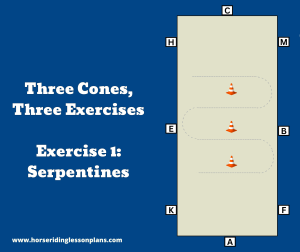
The Exercise: Ride a three-loop serpentine with the cones marking your crossing points in the middle of the arena. Each loop curves from one side of the arena to the other, crossing the centerline (where your cones are) between cones.
How to Ride It:
Start on one side of the arena and ride a curved loop toward the centerline. Cross the centerline just after passing the first cone. Continue your arc to reach the opposite side of the arena, then curve back toward the centerline, crossing just after the second cone. Arc to the opposite side again, curve back, and cross after the third cone. Your path creates three connected loops - a classic serpentine pattern.
The cones mark where you cross the centerline on each loop, providing visual accountability for spacing and geometry.
The Benefits:
- Straightness: Each centerline crossing should be straight - the cones reveal whether you're actually crossing perpendicular or drifting at an angle
- Accuracy: Even loops require planning - too tight on first loop leaves no room for remaining loops, too wide and you run out of arena space
- Bend Changes: Three loops mean multiple bend changes (right to left to right, or left to right to left) testing smooth transitions
- Teamwork: You and your horse must work together to maintain geometry while executing clean bend changes
Mix It Up:
- Add Transitions: Walk one loop, trot the next loop, canter the third loop. Or trot-walk-trot at each centerline crossing.
- More Cones = More Loops: Add a fourth or fifth cone to create four-loop or five-loop serpentines with tighter, more frequent bend changes.
- Tighter Spacing: Move cones closer together to create smaller loops requiring more collection and sharper turns.
- Count Strides: Decide each loop should be exactly X strides, creating precision work beyond just geometry.
- Reverse Direction: Work serpentines both ways - starting from opposite end or tracking opposite direction changes which loops require which bends.
EXERCISE 2: CONE WEAVING
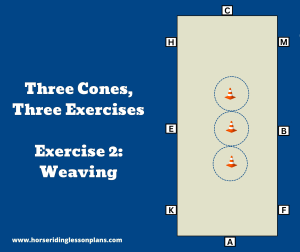
The Exercise: Weave between the cones traveling up the arena (think slalom skiing - passing to the right of one cone, left of the next, right of the third). When you reach the top cone, loop around it, then weave back down between the cones in the opposite pattern.
How to Ride It:
Start at one end of your cone line. Ride toward the first cone, passing to one side of it (let's say right side). Turn to pass the second cone on the opposite side (left side). Turn again to pass the third cone on the right side. You're weaving back and forth between cones.
When you reach the last cone, make a loop around it (essentially a small circle or teardrop turn), then weave back down - now you'll pass cones on opposite sides from your first pass.
The Benefits:
- Strength: The frequent direction changes and turns build muscular strength through the horse's body
- Flexibility: Constant bending left and right develops suppleness on both sides
- Balance: Navigating tight turns between cones requires sophisticated balance at all gaits
- Fine-Tuned Aids: You learn to apply minimal pressure for maximum response - harsh aids don't work well for precise navigation
- Responsiveness: The horse must react promptly to steering aids or you miss cones entirely
Mix It Up:
- Vary Loop Sizes: Make tight turns around cones (almost touching them) or wider sweeping loops around cones. Different sizes create different balance demands.
- Add Halts: Halt when positioned between two cones, hold it, then resume and continue weaving. Tests halt precision and responsiveness.
- Different Gaits: Weave at walk, trot, or canter. Each gait changes difficulty significantly.
- Spirals Around Cones: Instead of just passing cones, spiral in and out around each one before proceeding to the next.
- Lateral Work: Leg yield or shoulder-in between cones instead of straight lines. Combines weaving with lateral movements.
- Backwards Weaving: Advanced - rein-back through the weave pattern. Very challenging coordination.
- Ride Circles: Instead of weaving the cones, you can ride circles around them.
EXERCISE 3: CONE LEG YIELD
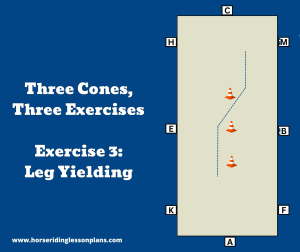
The Exercise: Ride past the first cone, then leg yield your horse diagonally past the next two cones. The cones mark your path and provide targets for the lateral movement.
How to Ride It:
Approach the first cone riding straight (on the centerline or parallel to it). As you pass the first cone, initiate leg yield. Your horse should move diagonally - both forward and sideways - past the second cone and continuing to the third cone.
The leg yield takes you from one side of the cone line to the other side, crossing past the second and third cones at an angle rather than straight.
The Benefits:
- Suppleness: Leg yield requires the horse to move laterally while maintaining forward motion, developing flexibility
- Responsiveness Awareness: Focusing on achieving the movement between specific cones (not just vague "leg yield for a while") gives clear feedback about how responsive your horse actually is
- Preparation Practice: You learn how early you need to prepare - if you wait until you're at the second cone to start leg yielding, you'll miss the target entirely
- Precision: The cones create concrete goals - either you leg yielded past them as planned or you didn't
- Aid Refinement: Smooth leg yield between cones requires coordinated aids, not just shoving sideways
Mix It Up:
- Decrease Cone Distance: Move cones closer together so you have to be extremely accurate with aids - there's less room for error with tight spacing
- Both Directions: Leg yield right (moving away from right leg) and leg yield left (moving away from left leg) for balanced work
- Vary Angle: Steeper leg yield angle (more sideways, less forward) or shallower angle (more forward, less sideways) changes difficulty
- Multiple Repetitions: Leg yield from cone 1 to cone 3, straighten, turn around, leg yield from cone 3 to cone 1
- Add Transitions: Walk past first cone, leg yield at trot past cones 2 and 3. Gait change adds complexity.
- Halt Between Cones: Leg yield to second cone, halt, leg yield to third cone. Tests whether lateral movement maintains through halts.
WHICH EXERCISE WHEN:
Serpentines: Great for warmup work, geometry practice, bend change development, or when you need flowing patterns that work both reins equally.
Weaving: Perfect for suppleness development, fine-tuning steering aids, building strength through turns, or adding challenge to basic riding.
Leg Yield: Best for lateral work practice, suppleness on specific rein, testing responsiveness, or when you want to work lateral movement with clear visual targets.
You can work all three in one session (maybe 5 minutes each) or dedicate entire sessions to one exercise depending on training focus.
BEGINNER-FRIENDLY TIPS:
- Start with generous cone spacing: 15-20 feet apart makes all three exercises achievable. Tighten spacing as skill improves.
- Walk first: Learn each pattern at walk before adding trot or canter speed.
- Serpentines easiest for most horses: Start there, progress to weaving, work up to leg yield (which requires lateral movement understanding).
- Cones are guides not obstacles: You're riding past/between them, not trying to avoid hitting them. They mark your path.
- Getting confused?: Work one exercise per session until familiar. Don't try to remember all three patterns in one ride initially.
- One exercise way harder?: Normal - maybe serpentines work great but weaving is disaster. Focus practice on the difficult one.
COMMON CHALLENGES:
- Serpentine loops uneven: First loop huge, last loop tiny. Plan spacing better - visualize how arena divides into three equal sections.
- Weaving becoming random turns: Should be smooth flowing pattern, not chaotic direction changes. Slower tempo, more deliberate steering.
- Hitting cones: Geometry or spacing is off. Widen cone spacing or work precision separately before attempting patterns.
- Losing impulsion: The steering/lateral demands make some horses slow down. Keep leg active throughout all exercises.
- One direction way easier: Standard asymmetry. Serpentines left-right-left flow beautifully, right-left-right are disasters.
PRO TRAINING TIP: The beauty of this three-cone setup is you can assess which exercise reveals weaknesses. If serpentines work great but weaving falls apart, tight turns and rapid bend changes need work. If weaving is fine but leg yield struggles, lateral movement needs development. The three different patterns serve as diagnostic tools.
For lesson programs, this setup is gold because multiple students can work different exercises simultaneously if you have enough arena space. One student serpentines while another weaves while a third practices leg yield - all using the same three cones in different ways.
The progression for most horses: serpentines first (flow and bend changes), weaving second (adds tight turns), leg yield third (adds lateral complexity) but some horses might find different order easier based on their strengths.
As exercises become easy, layer in the "Mix It Up" variations rather than just drilling the same basic patterns endlessly. The variations provide progressive challenge using the same setup.

Want More Lesson Plans?
RIDING INSTRUCTORS: Get instant access to the world's largest online library of lesson plans! Customizable exercises for every skill level, discipline, and teaching situation. Never run out of ideas again.
Join thousands of instructors who've transformed their teaching →