
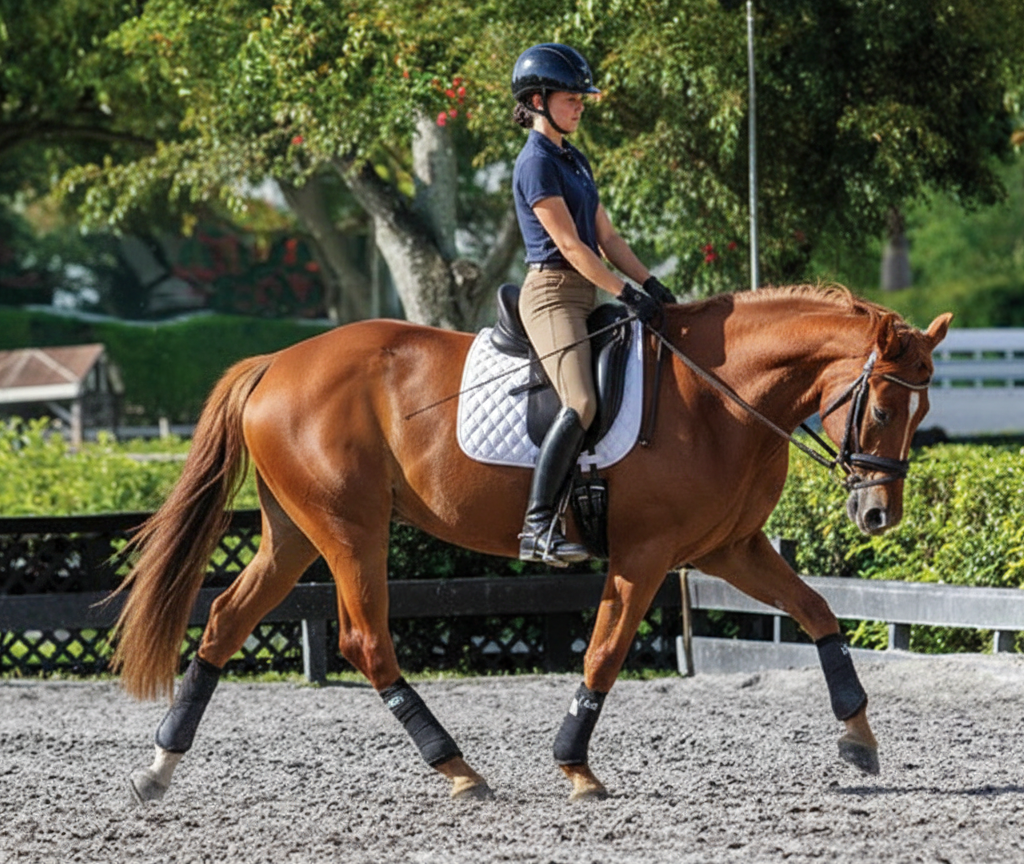
Let's be honest, most of us probably learned to post by pushing into stirrups and using momentum. Once you understand the actual biomechanics, you realize we've been missing the most critical piece: thigh rotation.
This approach transforms how students post - from stirrup-dependent bouncing to secure, efficient mechanics. Here's how to teach it:
THE MECHANICS YOUR STUDENTS NEED TO UNDERSTAND
The Real Motion
Rising trot isn't vertical bouncing. It's a controlled circular arc where the pelvis travels up and forward toward the horse's neck. The knees act as the fulcrum and stay glued to the saddle throughout the entire posting cycle. This is non-negotiable... if their knees lift off, the entire system breaks down.
The Missing Piece: Thigh Rotation
This is what most instructors never explain because we may not have been taught it ourselves.
When sitting:
- Kneecaps face forward
- Thighs relatively flat against saddle
- Hip angle closed
During the rise:
- Thighs rotate to vertical position
- Kneecaps point downward
- Lower third of thigh engages and grips
- Hip angle opens
This rotation creates the leverage for controlled posting - not the stirrups or shoulders. It is the thighs and once students understand this, everything clicks.
WHY TRADITIONAL TEACHING CREATES PROBLEMS
We typically teach: "Push into your stirrups and stand up" but this creates:
- Stirrup dependency (lose one = lose balance)
- Upper body compensation
- Rapid fatigue
- Bouncing that's uncomfortable for the horse
- Inability to post without stirrups
What we should be developing:
- Knee stability on the saddle
- Thigh rotation and engagement
- Unified torso movement
- Neutral spine alignment
- Efficient, sustainable mechanics
THE FOUR PHASES OF PROPER POSTING
Break it down for your students like this:
Phase 1: Sitting
- Seat bones in saddle, knees on saddle
- Thighs flat, kneecaps forward
- Hip angle closed, spine neutral
Phase 2: Rising
- Thighs rotate (lower third engages)
- Kneecaps rotate downward
- Pelvis travels up AND forward in arc
- Hip angle opens
- Knees stay on saddle
- Torso moves as one unit
Phase 3: Peak
- Maximum hip angle
- Thighs vertical
- Weight through thighs, not stirrups
- Knees still on saddle
Phase 4: Descent
- Controlled lowering
- Thighs rotate back
- Hip angle closes
- Soft landing
Throughout all phases: spine neutral, torso unified, knees planted.
COMMON STUDENT ERRORS AND HOW TO FIX THEM
Error: Shoulder-Initiated Rising
What you see: Student leads with shoulders, creates hollow back
Your cue: "Shoulders and hips should move together. Initiate from your thighs, not your upper body."
Error: Stirrup Dependency
What you see: Pushing hard into stirrups to launch upward
Your cue: "Let the horse's bounce give you momentum. Your thighs control it and stirrups are just foot rests."
Your fix: Regular no-stirrup work to break the dependency
Error: Vertical Bouncing
What you see: Straight up and down like a pogo stick
Your cue: "Up and forward in an arc - your pelvis travels toward the horse's neck, not toward the sky."
Error: Collapsing at the Waist
What you see: Excessive forward fold, breaking at hip joint
Your cue: "Hip angle opens and closes, but don't collapse forward. Maintain torso integrity."
Error: Inconsistent Rhythm
What you see: Posting doesn't match trot beats
Your fix: Develop muscle memory through ground work first, then apply timing mounted
THE GROUND EXERCISE THAT CHANGES EVERYTHING
This is your secret weapon for teaching proper mechanics. Have students do this before you even address posting mounted.
Kneeling Position Practice
Setup:
- Student kneels on floor (yoga mat for comfort)
- Knees hip-width apart
- Sitting back on heels
- Torso vertical
Coach Through These Points:
- "Rise using ONLY your thigh muscles. No pushing with feet, no leaning with shoulders"
- "Keep your spine neutral. I should see the same curve whether you're sitting or rising"
- "Move your entire torso as one unit. Imagine it's a wooden plank"
- "Feel your hip angle close when sitting, open when rising. This is exactly what happens on the horse"
- "Notice your thighs rotating. Feel that lower third engaging and remember this sensation."
Coaching Tips:
Start them slow with 10-15 controlled reps focusing on form. Have them self-check by placing one hand on lower back to monitor spine. Watch for shoulder-leading and correct immediately. Video students as most think they're doing it right until they see themselves. Assign as homework: 5 minutes daily for two weeks
TEACHING PROGRESSION: GROUND TO MOUNTED
Ground Exercise Introduction
- Demonstrate it yourself first
- Have them try it (in arena or barn aisle)
- Coach through common errors
- Explain WHY this matters
- Assign daily practice
Applying to Mounted Work
- Brief ground exercise review
- Mount and practice the rising motion at halt first
- "Feel the same thigh engagement you just felt on the ground"
- Progress: walk, sitting trot, posting trot
- Keep stirrups initially for security
No-Stirrup Application
- Start with 2-3 minute intervals
- Coach: "Thighs rotate, torso stays solid, knees glued to saddle"
- If they struggle, dismount and return to ground exercise
VERBAL CUES THAT ACTUALLY WORK
Use these:
- "Thighs rotate, knees stay stuck"
- "Torso is a solid block"
- "Up and forward, not up and back"
- "Let the horse's bounce give you momentum"
- "Kneecaps point down when you rise"
Avoid these:
- "Just post" (gives no information)
- "Push into your stirrups" (creates wrong pattern)
- "Stand up" (promotes dependency)
HOW TO ASSESS IF THEY'VE GOT IT
Your student has mastered proper mechanics when they can:
- Post comfortably without stirrups for 5+ minutes
- Maintain consistent rhythm with the horse
- Keep knees on saddle throughout
- Move torso as unified block
- Articulate what they're feeling (thigh rotation, hip angle changes)
- Look stable and secure, not precarious
BENEFITS YOU'LL SEE IN YOUR PROGRAM
For Students:
- True security without stirrup dependency
- Reduced fatigue and increased endurance
- Better balance through transitions
- Foundation for advanced work
- Genuine understanding of their own biomechanics
For Lesson Horses:
- More comfortable under consistent, balanced riders
- Better ability to use their backs
- Reduced strain and stress
- Longer working soundness
ADVANCED APPLICATIONS
Once students master basic mechanics, you can:
Integrate with Sitting Trot Same thigh engagement principles apply to sitting stability
Work on Lengthening and Collection Adjust posting to different trot tempos while maintaining form
Develop Two-Point Thigh rotation and knee stability transfer directly to jumping position
Test Without Reins Arms folded or out - proves they're not balancing on reins
IMPLEMENTATION IN YOUR PROGRAM
Warm-Up Routine: 5-minute ground exercise before mounting
Skill Building: Progressive no-stirrup work in every lesson
Assessment: Video analysis comparing position from previous lessobs
Homework: Daily ground exercise for muscle memory
THE BOTTOM LINE FOR INSTRUCTORS
This approach requires more initial teaching time than just push into your stirrups and post but the payoff is massive:
- Students develop genuine skill mastery, not compensation patterns
- Your lesson horses stay sounder longer under properly balanced riders
- Students progress faster in advanced work because they have proper foundation
- You build riders who can self-correct and understand their own mechanics
Most instructors teach posting the way they learned it - without understanding the biomechanics. Once you decode it and teach it systematically, you'll see dramatic improvements in your students.
Your students will thank you, your horses will thank you, and you'll be a better instructor for understanding and teaching this correctly.
Try this in your next lesson: Before mounting, have your student do 10 kneeling rises. Have them notice the thigh rotation and hip angle changes. Then mount and immediately post - they'll feel the connection. That's when the lightbulb goes on.

Want More Lesson Plans?
Stop spending hours creating lesson plans from scratch! Our massive online library gives you proven exercises for any rider, any discipline, any weather. Group lessons, private lessons, games, warm-ups - it's all here.
Get instant access to lesson plans →