
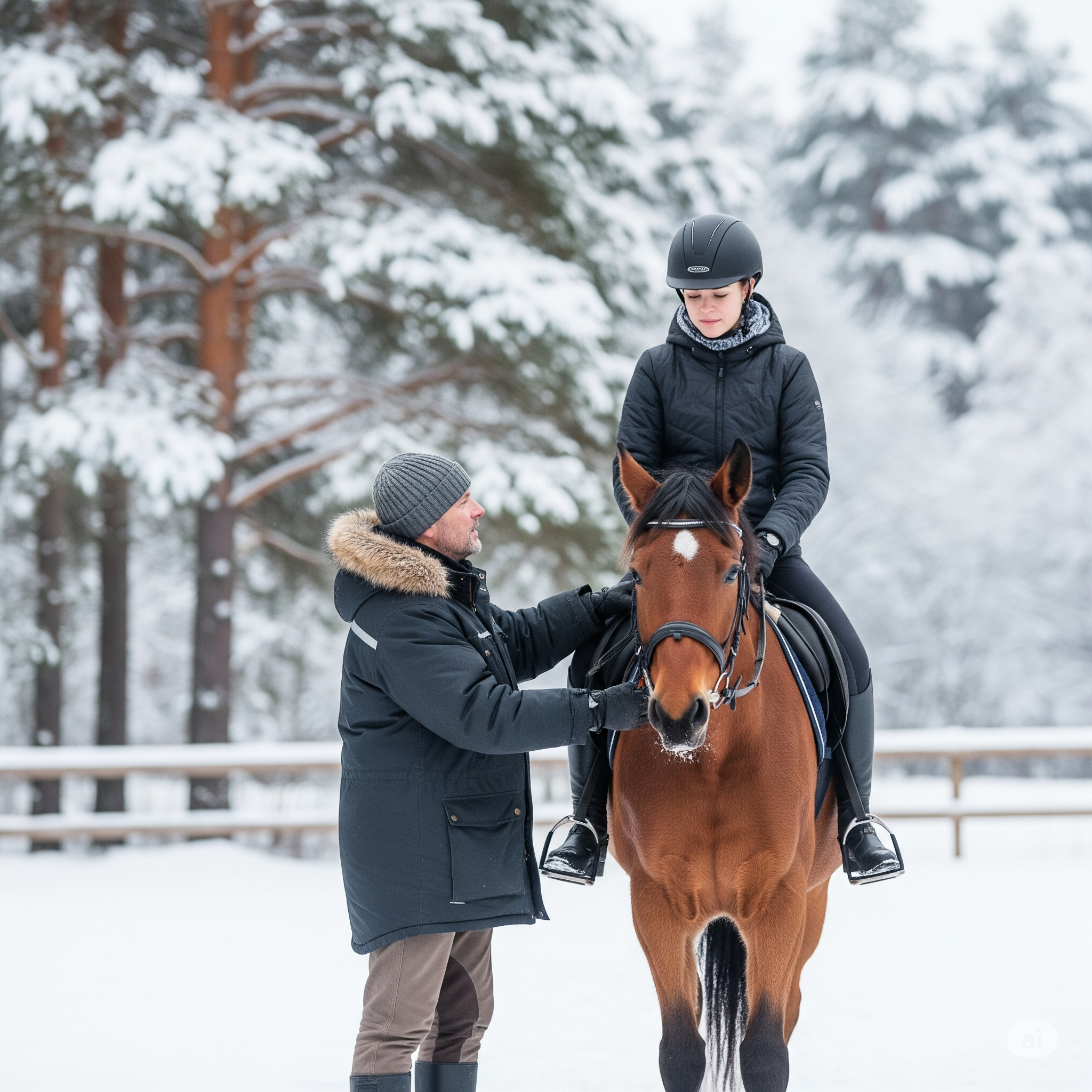
Winter doesn't have to mean boring! With the right activities, you can actually use the slower season to build skills that are harder to develop during busy lesson schedules.
Here are some of the best winter lesson ideas that keep students engaged while developing real riding skills.
PAS DE DEUX: SYNCHRONIZED RIDING
This one sounds fancy but it's genuinely one of the most effective exercises for developing spatial awareness, precision, and rider independence plus students LOVE it.
Pas de deux is simply two horses and riders performing synchronized movements together. Think of it like a choreographed routine where both riders have to match each other's timing, transitions, and patterns.
How to teach it:
Basic Level (Walk and Trot):
Pair two riders of similar skill levels.
"You're going to ride the same movements at the same time. Walk together, halt together, turn together. Watch each other as much as you watch where you're going."
Start with simple parallel lines down the long side. Both riders walk together, halt at the same marker, walk on together. Sounds easy but it's not. Students quickly realize how much they rely on just following the track rather than actually controlling their horses precisely.
Intermediate Level:
Add trot transitions and basic geometric patterns.
"Tracking left, both of you trot at A. Walk at C. Make a 20-meter circle at E together."
Add some music! Helps riders to think about rhythm and flow rather than just survival.
Advanced Level:
Mirror image movements, counter canter work, more complex dressage movements performed simultaneously.
For your advanced students this is genuinely challenging even for experienced riders.
Practical uses:
Private lessons: Ride alongside your student yourself. You become the "partner" and can guide the movements in real time while demonstrating correct position and timing.
Assessment tool: Pas de deux reveals independence or lack of it immediately. A student who can't maintain their own rhythm while matching someone else doesn't have truly independent riding yet.
Performance preparation: Build a simple routine for a barn demonstration or small in-house show. Students work toward something and it gives winter riding a purpose.
Red Light Green Light
Simple, effective, works for every level.
Basic version: "Green light means walk. Red light means halt. Simple." Run it a few times at walk, then add complexity.
Advanced version:
- Green = trot
- Yellow = walk
- Red = halt
- Flashing red = back up
Call transitions randomly and watch how quickly students improve their responsiveness and balance through transitions when there's a game element involved.
Safety note: Emphasize smooth balanced transitions over speed. The goal isn't who halts fastest - it's who halts most balanced.
Simon Says (Mounted Version)
Students think this is just a game but you know it's position and transition work disguised as fun.
How to run it:
Position commands: "Simon says rise in your stirrups" "Simon says sitting trot" "Simon says two-point position"
Transition commands: "Simon says walk" "Simon says halt" "Trot" (without "Simon says" - anyone who trots is out)
Direction and pattern commands: "Simon says turn left" "Simon says 20-meter circle at C" "Simon says change the rein"
Safety commands: Mix in safety-focused commands to reinforce protocols while playing: "Simon says check your diagonal" "Simon says check your girth"
Teaching tip: Use elimination carefully with nervous students. Sometimes keeping everyone in but tracking who would have been eliminated works better for confidence.
The Dollar Bill Challenge
Students put dollar bills (or paper substitutes) under their thighs, calves, or between their seat and saddle. Their job is to keep them there.
How to teach it:
Start at halt.
"Place the bill under your thigh. Feel how your leg has to maintain consistent contact to keep it there? Not gripping - just consistent soft contact."
Progress through walk, then trot once they're successful at walk.
Add challenges:
- Transitions (bills fall during transitions = loss of position)
- Directional changes
- Posting trot (bill between seat and saddle really reveals posting quality)
- Canter for advanced riders
Competitive version: Last rider with their bill still in place wins.
Teaching moment: When a bill falls, use it immediately. "It fell during that transition so what happened to your position right there?"
Why it works: Immediate, objective feedback that students can't argue with. Either the bill is there or it isn't.
ARENA TREASURE HUNT
Use barn equipment and educational props.
Setup:
Place items around the arena on jump standards, fence posts, or other safe points:
- Brushes
- Crops
- Bandages
- Small cones
- Anything educational you have lying around
Provide a bucket per team for collection.
Basic version: Navigate to items, collect them, deposit in bucket. Most items collected wins.
Educational version: Attach quiz questions to items. Student can only keep the item if they answer the question correctly.
Questions like:
- "What does this brush do?"
- "Name three signs of colic"
Combines horsemanship education with riding practice. Students barely notice they're learning barn knowledge because they're focused on winning.
Team version: Split into teams. Each team member must collect minimum number of items. Collaboration and strategic planning required.
Safety notes:
- All items safely positioned and easily retrievable
- Nothing that could spook horses if knocked over
- Adequate spacing between riders
Pattern Work in Snow
If you have outdoor space with snow, use it. Snow is one of the best teaching tools you'll ever have because it shows you EXACTLY what your students are actually riding versus what they think they're riding.
How to use it:
Have your student ride a circle in fresh snow. Then walk over and look at the tracks together.
"Is that a circle? Or is it a weird egg shape? See how it falls in on this side? That's where you're losing bend."
The tracks don't lie. Students can see their own accuracy or lack of it in a way that's impossible to argue with.
Geometric patterns: Have students design and ride specific shapes:
- Perfect circles
- Squares with straight sides and actual corners
- Figure eights with equal-sized circles
- Serpentines with even loops
Analyze the tracks together. Identify where straightness is lost, where circles collapse, where rhythm changes.
Following exercises: Ride a pattern in the snow and have students follow your exact tracks. Great for teaching precision and track accuracy.
Multi-gait analysis: Have students walk, trot, and canter the same circle and compare the stride patterns in the snow. Great visual lesson about how gait affects movement and rhythm.
COLLECTION AND EXTENSION WORK
Winter's controlled indoor environment is actually perfect for developing adjustability within gaits - something that gets harder to focus on during busy show season.
How to teach it:
Long side/short side work:
"On the long sides I want you to ask for more forward energy - extended walk, more impulsion. On the short sides collect it back - shorter, more engaged steps."
This teaches students to:
- Actually influence their horse's stride length
- Feel the difference between forward and collected
- Use half halts effectively
Progressive development:
Walk variations: Start here. Walk is forgiving enough to feel the differences clearly.
"Free walk - let the reins out, let the horse stretch. Working walk - contact back, regular rhythm. Collected walk - shorter steps, more engagement."
Have students feel the difference rather than just describing it. "What changes in your body when the walk gets more collected?"
Trot adjustability: Once walk variations are clear, apply the same concept to trot.
"Working trot on the long sides. Collected trot through the short sides and corners. Feel how the rhythm stays the same but the stride changes."
Canter (advanced students):Adjustable canter is a big deal for jumping and dressage students. Winter is the perfect time to develop it.
"More forward on the long sides. Collected through corners. Rhythm stays consistent - just adjust the stride."
BAREBACK RIDING (WHEN APPROPRIATE)
If you have appropriate students and suitable horses, winter is actually a great time for bareback work as the extra warmth from the horse is a genuine bonus on cold days!
Non-negotiable requirements:
- Experienced, balanced riders only
- Calmest, most reliable horses in your program
- Helmet always
- Walk only initially
- Short sessions as fatigue comes faster bareback
- Close supervision
How to introduce it:
Start at halt. Let the student feel the horse's warmth and movement without any gait.
"Feel the horse's back muscles under you. Notice how you automatically adjust your balance? That's what we're trying to develop."
Walk only for first session. No more than 10-15 minutes. Progress to short trot intervals only when walk is genuinely secure and comfortable.
What to watch for:
- Gripping with knees (creates instability without saddle)
- Tipping forward for security
- Student tensing during any unexpected movement
- Fatigue - students won't always tell you when they're done
When NOT to use bareback:
- Nervous or anxious students
- Students who don't have genuine balance at all gaits with stirrups first
- Anything other than your deadest, most reliable horses
PROGRAM IMPLEMENTATION: MAKING WINTER WORK
Weather adaptability:
Have a plan A, B, and C for every lesson day:
- Plan A: Normal riding lesson
- Plan B: Modified lesson (games, precision work) if footing is questionable
- Plan C: Unmounted lesson if riding isn't safe
Students appreciate knowing you have a plan regardless of weather.
Skill integration:
Don't treat winter activities as separate from regular training. Every game and exercise should connect back to fundamental skills:
Red light green light = transition quality
Dollar bill challenge = independent seat
Pas de deux = precision and independence
Pattern work in snow = accuracy and geometry
Collection work = adjustability and feel
Always connect the activity to the skill. "We're playing this game because it develops the same transitions you need for your dressage test."
Keeping horses fit through winter:
Students aren't the only ones who get bored with winter arena circles. Mix up horse workouts too:
- Variety of exercises keeps horses mentally engaged
- Collection and extension work builds fitness without excessive mileage
- Games keep horses responsive and forward
- Pas de deux work develops straightness and obedience
COMMON WINTER TEACHING MISTAKES:
Mistake 1: Canceling instead of adapting
Bad footing doesn't always mean no lesson. Unmounted horsemanship education, groundwork, or modified exercises in safe areas keep students engaged and paying through winter.
Mistake 2: Doing the same thing every lesson
Winter is actually the best time to try new exercises because show season pressure is off so use it.
Mistake 3: Ignoring horse fitness
Horses standing in stalls all winter lose fitness fast. Keep them moving with varied, interesting work.
Mistake 4: Treating winter as dead time
The instructors who use winter intentionally come out in spring with students who've genuinely improved. The ones who just survive winter come out in spring starting over.
Winter doesn't have to be your worst season! With the right activities it can actually be your most productive one - lower pressure, more time for foundational work, and creative exercises that build skills you don't have time for during busy show season. Use the snow, use the indoor if you're lucky, and use these games that develop real skills. Your students will come out in spring better than they went in... that's the goal.

Want More Lesson Plans?
Join 5,000+ instructors who've already discovered the secret to engaging lessons! The world's largest collection of customizable lesson plans, exercises, and activities - ready to download instantly.