
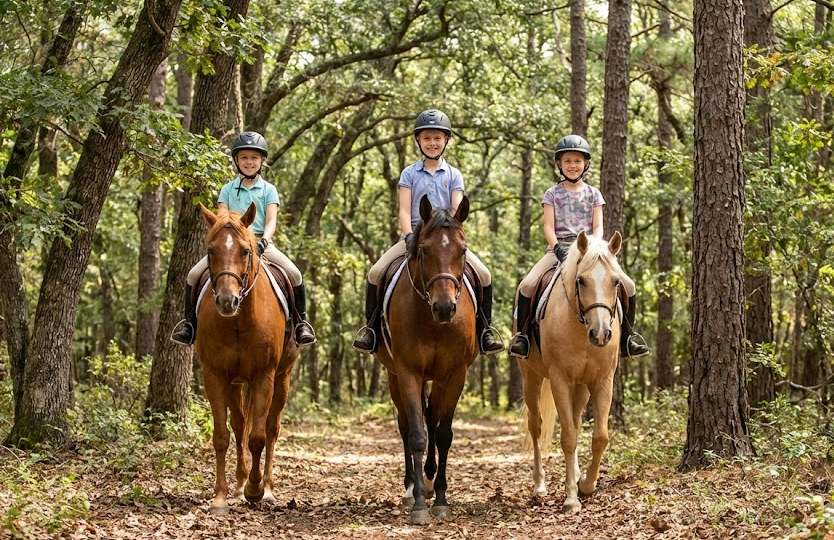
Trail rides are great. Students love them, horses enjoy the change of scenery, and everyone comes back in a better mood! After the tenth trail ride of the season, "let's go for a trail ride" starts to feel routine. Students zone out and the educational value drops to basically zero.
The nature scavenger hunt game fixes that. Same trail ride, completely different energy. Students are engaged, competitive, and learning while having fun. Here's how to set it up and run it well:
WHAT IT IS
Simple concept: students collect points by spotting specific wildlife, plants, and natural features during the trail ride.
STEP 1: BUILD YOUR OBSERVATION LIST
This is where most of the preparation happens and it's worth doing right. Your list needs to be specific to YOUR area. A list with "palm tree" on it doesn't work in Minnesota. A list with "moose" doesn't work in Texas.
Walk your trail routes before building the list. What do you actually see regularly? What's seasonal? What would be a rare exciting find?
Build three versions of the list based on age:
Young riders (ages 5-8) - Keep it simple and obvious:
Use broad easy categories they can actually find:
- Any bird flying
- A pink flower
- A tree with a hole in it
- A squirrel
- A butterfly
- A puddle or stream
- Something that's the color yellow in nature
5-7 items maximum. Attention spans are short and frustration kills the game fast.
Intermediate riders (ages 9-13) - Get more specific:
- A red cardinal
- A white-tailed deer (or tracks)
- An oak tree
- A bird's nest
- A frog or toad
- Wildflowers (identify the color and type)
- Animal tracks (identify which animal)
- Evidence of an animal eating something
8-12 items. They can handle more challenge and will actually enjoy the identification aspect.
Advanced riders (ages 14+) - Make them work for it:
- Specific bird species by name
- Plant families not just individual plants
- Behavioral observations ("deer feeding," "bird building nest," "hawk hunting")
- Signs of ecosystem activity (fresh tracks, scat, disturbed vegetation)
- Invasive vs native plant identification
- Evidence of seasonal change
Use scientific names where appropriate. These students can handle it and it adds educational depth.
STEP 2: DECIDE YOUR POINT SYSTEM
Option 1: Equal points (1 point for everything)
Best for: Young kids, mixed ability groups, first time playing
Keeps it simple. Reduces competitive pressure. Focuses on observation and participation rather than winning.
Option 2: Difficulty-based points
Best for: Intermediate and advanced groups, returning players who've done it before
Common sightings = 1 point (birds, squirrels, common flowers) Moderate challenge = 2 points (specific species, seasonal finds) Rare discoveries = 3 points (unusual wildlife, hard-to-find plants, behavioral observations)
Creates strategy - students have to decide whether to spend time hunting for rare high-value items or rack up points with common sightings.
Option 3: Team scoring
Pair riders or create small groups. Teams share points for collaborative observations.
Best for: Mixed ability groups where you want experienced riders helping younger ones. Also great for building communication and collaboration skills.
STEP 3: DECIDE HOW TO RECORD OBSERVATIONS
Honor system:
Students track their own points.
Best for: Older students and groups you trust. Builds integrity and self-monitoring.
Simple to manage - you're not keeping track of everyone's scores.
Buddy system:
Pair riders who verify each other's observations before points count.
Best for: Most groups. Builds accountability without putting all the administrative burden on you.
"You can only count it if your buddy saw it too." Reduces arguments and keeps everyone engaged since they're watching for their buddy's observations too.
Instructor documentation:
You or a designated helper keeps the official score.
Best for: Younger children or formal programs where accuracy really matters.
More work for you but ensures accuracy and gives you assessment data.
STEP 4: CHOOSE YOUR ROUTE
Not all routes work equally well for this game.
Farm pastures (horse-free areas):
Good for newer riders who need simpler terrain and closer supervision. Controlled environment, predictable observations, easy to manage.
Downside: Limited habitat variety means the list gets repetitive quickly.
Established trail systems:
Best option for varied observations and authentic wildlife encounters. Different habitats mean more diverse sightings.
Requires more careful group management and route planning for safety.
Route selection checklist:
- Appropriate for weakest rider in the group (not the strongest)
- Good visibility for wildlife observation
- Safe footing throughout
- Manageable group supervision
- Known hazards identified and addressed in pre-ride briefing
STEP 5: PRE-RIDE PREPARATION
Don't just hand out the list and go. A few minutes of preparation dramatically improves the game.
Observation technique briefing:
"Instead of just looking randomly, scan systematically. Near ground first, then mid-height, then up in the trees. Move your eyes in sections."
"Quiet riding means more wildlife sightings. The louder and more chaotic the group, the less we'll see."
This actually improves their riding too - calm, quiet, focused riding is better riding regardless of what they're looking for.
Establish wildlife encounter protocols:
"If someone spots a deer, do NOT point and yell. Quietly say 'deer at two o'clock' so we don't spook it or the horses."
"Safe observation distance from wildlife. We watch, we don't approach."
RUNNING THE GAME
During the ride:
When a student spots something on the list they call it out for verification. Buddy or instructor confirms, points get recorded. Use sightings as brief teaching moments with an emphasis on BRIEF. A 30-second interesting fact about what they spotted adds educational value without killing the momentum.
"Great - that's a red-tailed hawk. See how it's circling? It's hunting. Red-tailed hawks are one of the most common hawks in North America."
Then move on... don't turn every sighting into a five-minute lecture.
Instructor running commentary:
Point out interesting things NOT on the list as you ride.
"See that mound over there? That's a groundhog burrow."
"Notice how the trees change here? We're moving from open meadow into woodland - that's called an ecotone and you'll see different animals here."
This keeps students actively looking and adds depth without making it feel like a classroom.
Managing competitive dynamics:
Some students will get upset if they're behind on points. Redirect: "You're behind on points but you've spotted the most things overall - just not the ones on the list. Let's focus on finding that deer track before we head back."
Keep the atmosphere collaborative even when it's competitive.
AFTER THE RIDE
Point tally and results:
Count up points and declare a winner while keeping the atmosphere positive for everyone. Don't just announce results and move on. Use the moment:
"Sarah won with 14 points. The rarest thing anyone spotted today was the great blue heron at the pond. Who can tell me something interesting about herons?"
Group discussion:
"What was the most surprising thing you saw today?" "What did you NOT see that you expected to? Why might that be?" "How was today's ride different from last month? What's changed seasonally?"
These discussions build genuine environmental literacy without feeling like a test.
Identification verification:
If there were any disputed sightings or uncertain identifications, look them up together using field guides or your phone. Modeling how to verify and research information is genuinely valuable.
Connect to conservation:
Link what they saw to bigger environmental concepts.
"We saw three deer today. Twenty years ago that trail was completely deforested and there were no deer. Conservation efforts brought them back."
Brief, relevant, memorable.
VARIATIONS TO KEEP IT FRESH
Seasonal versions:
Build different lists for each season. Spring migration birds, summer wildflowers, fall color changes, winter tracks in snow.
Students who ride year-round get a completely different experience each season and start to understand how ecosystems change.
Photography version:
Allow students to photograph discoveries with a designated device (barn phone or tablet, not personal phones).
Review photos together after the ride. Great for uncertain identifications and creates a visual record of what you've seen across seasons.
Citizen science integration:
Connect observations to actual research programs like eBird for bird sightings or iNaturalist for general wildlife.
Students realize their observations have real scientific value. Surprisingly motivating for older students especially.
Competitive team version:
Split into two teams taking slightly different routes that converge at a meeting point. Teams compare observations at the meeting point before completing the ride together. Creates strategy, communication, and a genuinely exciting mid-ride reveal.
CONNECTING IT BACK TO HORSEMANSHIP
This isn't just a nature game. There are genuine horsemanship lessons happening here.
Quiet, calm riding produces better results. Students who ride calmly see more wildlife. Students who are bouncy, loud, and distracted see nothing. The game teaches quiet riding better than telling them to be quiet ever will.
Awareness and observation transfer directly to riding. Students who learn to scan their environment become more aware riders. They notice changes in their horse's behavior earlier. They see potential hazards before they become problems.
Trail horses behave better with focused, calm riders. Students who are genuinely engaged and quietly focused on observation tend to have better trail rides than students who are bored and unfocused.
Point all of this out explicitly after the ride. "You know what I noticed? When you were focused on spotting wildlife, your riding got quieter and more balanced. That's not a coincidence."
Routine trail rides have their place but trail rides with purpose where students are engaged, competitive, learning, and genuinely paying attention are better for everyone. This game takes minimal preparation, works for every age and skill level, and creates trail ride memories that students actually talk about afterward. Build your regional list, run it once, adjust based on what worked.

Want More Lesson Plans?
Join 5,000+ instructors who've already discovered the secret to engaging lessons! The world's largest collection of customizable lesson plans, exercises, and activities - ready to download instantly.