
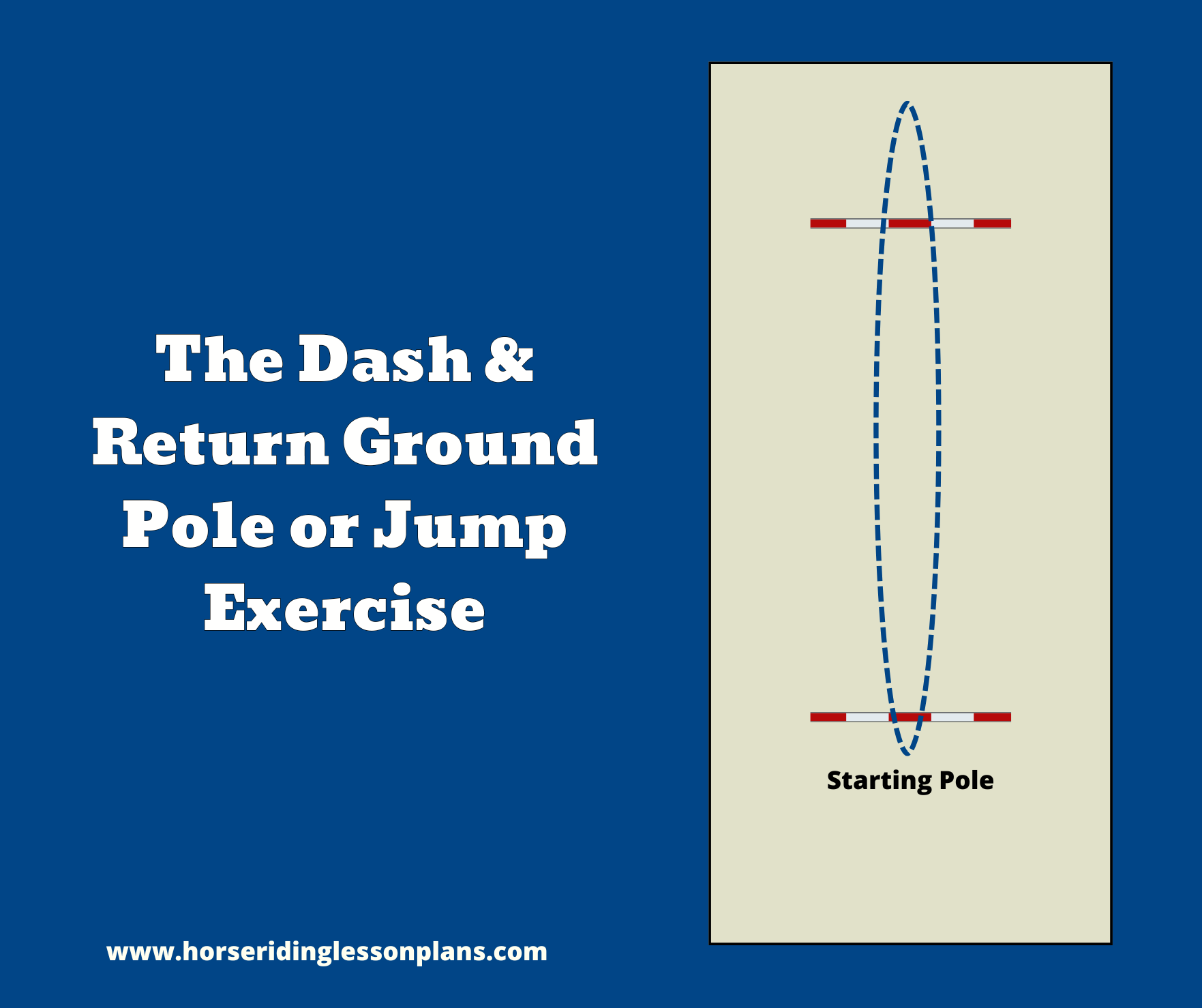
Want to bring some excitement into your flatwork or jumping lessons while building genuine steering, turn technique, and speed control? Borrow a concept from western gaming and adapt it for any discipline. Set up two ground poles or jumps at opposite ends of your arena and ride a there-and-back dash pattern that develops precision turns, rhythm maintenance, and competitive engagement. Works for every discipline, every level, and makes riders genuinely try harder than they would in standard flatwork.
WHAT IT IS: Two obstacles (ground poles, cross-rails, or verticals depending on level) placed at opposite ends of your arena as far apart as possible. You'll cross the first obstacle heading toward the second, navigate the second obstacle, execute a turn, and return back over the first obstacle. Simple pattern, multiple skill demands - straight lines, perpendicular approaches, balanced turns, and rhythm throughout. Add timing or judging criteria and it becomes a competitive exercise that riders genuinely work to win.
WHAT YOU NEED:
- 2 ground poles minimum (progress to cross-rails or verticals as skill builds)
- Position them at opposite ends of available arena space - maximum distance between them
- Clear start/finish line at one obstacle (one end is your "start line," the other is your "turn point")
- Optional: phone stopwatch for timed versions
- Horse with basic steering and obstacle comfort
WHY THIS WORKS:
Placing obstacles at maximum arena distance creates the longest possible straight-line approach on each pass. This gives riders adequate time to prepare turns while also allowing natural speed development on the return - you're not cramped into a tight space making rushed decisions.
The turn at each end is the primary skill challenge. Done correctly (inside leg pushing into the turn, outside aids supporting, horse bent and balanced) it feels smooth and flowing. Done incorrectly (pulling on inside rein, passive legs, horse falling in or cutting the turn) it feels rough and unbalanced. The exercise immediately reveals which approach your riders are using. You can also instruct riders to make a nice sweeping turn vs a tighter turn.
The competitive format (timing or judging) creates genuine motivation. Riders who would produce mediocre circles in basic flatwork suddenly try much harder when there's a stopwatch running or a judge watching. That competitive energy produces better riding through heightened focus.
The cross-disciplinary nature means every rider in your program benefits - not just western-oriented students. Precision approaches, balanced turns, and speed control matter in dressage, jumping, trail, and any discipline requiring accurate steering.
THE SETUP:
Obstacle 1 (Start/Finish Line): Position one pole or jump perpendicular to the long side of your arena at one end. This is your starting point AND the finish line on the return pass.
Obstacle 2 (Turn Point): Position second pole or jump at the opposite end of your arena, parallel to the first obstacle. This is where you'll execute your 180-degree turn.
Maximum Distance: Place them as far apart as your arena allows - the longer the straight sections, the more effective the exercise.
THE PATTERN - STEP BY STEP:
Phase 1: Cross Start/Finish (Obstacle 1)
Begin before the first obstacle and cross it with controlled forward momentum in your chosen gait (walk, trot, or canter). Your timer starts as front feet cross the line if timing the exercise.
Phase 2: Straight Line Approach to Obstacle 2
Ride a straight line toward the far obstacle. Perpendicular approach - you should be aimed squarely at the center of the obstacle, not drifting or angling. Prepare mentally for the turn coming up.
Phase 3: Navigate Obstacle 2
Cross over (or navigate around, depending on exercise version) the second obstacle at the far end. Maintain rhythm - don't rush or slow dramatically at the obstacle itself.
Phase 4: Turn
Immediately after the second obstacle, execute a turn to reverse direction. This turn is the technical heart of the exercise.
Correct Turn Technique:
- Active inside leg at the girth creates bend and maintains forward momentum through the turn
- Outside leg behind the girth controls the hindquarters
- Outside rein provides stability - doesn't let the horse fall out
- Weight slightly toward inside without collapsing or leaning
- Eyes looking ahead to the new direction immediately
What NOT to Do:
- Don't pull on the inside rein to yank around the turn - creates resistance, kills momentum, unbalances horse
- Don't drop legs passive - horse falls in or cuts the turn
- Don't lean or tip forward through the turn
- Don't wait until after the turn to prepare - look ahead BEFORE completing the turn
Phase 5: Straight Return to Obstacle 1
After the turn, ride a straight line back toward the first obstacle. Perpendicular approach again - square to the obstacle, not angling.
Phase 6: Cross Start/Finish (Obstacle 1)
Cross the final obstacle cleanly. Timer stops on front feet crossing if timing the exercise.
The Complete Flow: Cross obstacle 1 → straight line to obstacle 2 → cross obstacle 2 → turn → straight line back → cross obstacle 1 → done.
BEGINNER-FRIENDLY TIPS:
- Start at walk: Learn the pattern, turn technique, and approach accuracy at walk before any speed pressure.
- Pull vs push turn: Every beginner will try to pull the inside rein. Teach "push into the turn with your leg" from the first attempt.
- Look ahead through turn: Eyes looking forward to new direction creates better turns than looking at the obstacle or down.
- Perpendicular approaches matter: Drifting toward obstacles at angles creates messy navigation. Aim square to the center every approach.
- Trot before canter: Never rush to canter before trot work is clean and organized.
- Rhythm throughout: Speed should stay consistent - not rushing at obstacles or slowing dramatically through turns.
WHAT TO FEEL FOR: The straight sections should feel organized and forward - moving purposefully toward each obstacle. The turns should feel flowing and balanced - not abrupt yanking that kills momentum or passive drifting that loses direction.
After a good turn, you should be immediately heading straight toward the return obstacle without steering corrections needed. If you need significant steering adjustments after turns, the turn itself wasn't balanced or accurate.
THE COMPETITIVE FORMATS - MAKING IT A GAME:
Format 1 - Finesse Competition (Style Judging)
Instead of timing, JUDGE the ride on technique. Perfect for developing quality over speed mentality.
Judging criteria:
- Turn quality (40% of score): Smoothness, balance, correct aids, no yanking or falling
- Approach accuracy (25%): Straight lines, perpendicular to obstacles, centered
- Rhythm consistency (20%): Tempo maintained throughout, no rushing or breaking
- Overall harmony (15%): Partnership quality, rider-horse communication
Works brilliantly in group lessons as each rider has a turn, everyone watches and learns to recognize quality. Works in private lessons too just give score feedback and let rider improve through multiple attempts.
The judging format teaches riders to value technique over speed - critical horsemanship concept that transfers everywhere.
Format 2 - Speed Competition (Timed Dash)
Time each run with a simple phone stopwatch:
- Start: Timer begins when front feet cross obstacle 1
- Finish: Timer stops when front feet cross obstacle 1 on return
- Multiple attempts: Personal best time competition
- Divisions: Separate timing for walk, trot, and canter so levels compete fairly
Competitive options:
- Personal best challenges (beat your own time) for private lessons
- Group competition across same gait division
- Team relay scoring
- Handicap adjustments by experience level
The speed format creates genuine competitive pressure that forces riders to develop efficiency. Sloppy turns waste time while clean balanced turns are also the fastest turns. This reveals that good technique and speed are the same thing.
WHY TECHNIQUE = SPEED:
One of the most valuable lessons this exercise teaches: the "push into the turn" technique is not just correct - it's FASTER than pulling. Yanking the inside rein slows the horse, creates resistance, and wastes strides. Inside leg pushing into a balanced turn maintains momentum and produces shorter, cleaner turns.
VARIATIONS TO TRY:
Gait Progressions: Walk only first session, trot second session, canter third session. Each gait has different demands - don't rush progression.
Jump Heights: Progress from ground poles → raised poles → cross-rails → verticals as jumping skill develops.
Obstacle Types: Mix and match. Maybe obstacle 1 is a ground pole and obstacle 2 is a cross-rail.
Style Then Speed Same Session: Finesse judging round first (emphasize technique), then timed rounds (apply technique under speed pressure). Natural progression within one lesson.
Multiple Obstacles: Instead of one obstacle at each end, place two in a row. Creates short combination work at each end.
Different Gaits Each End: Trot obstacle 1, canter to obstacle 2, trot turn, canter back. Integrates transitions.
PRO TRAINING TIP:
The "push vs pull" turn technique is the key teaching moment in this entire exercise. Every rider instinctively wants to pull the inside rein to turn the horse. The exercise reveals why that's wrong through direct consequence: the pulled turn is slower, rougher, and less balanced than the pushed turn.
The competitive format unlocks effort that basic flatwork drills don't produce. Riders who would do mediocre trot circles for 20 minutes without really trying will suddenly focus intensely when there's a stopwatch or a judge watching. Use this human nature intentionally, competition creates motivation.
The maximum arena distance between obstacles is important for safety especially at canter. Close obstacles don't allow adequate preparation time and can create rushing or unbalanced approaches. Use all available space.
For group lessons, run this as a class competition with everyone watching each run. Watching others reveals turn errors and good technique more clearly than just riding. Peer learning through observation accelerates individual improvement.
For horses that get excited or strong in competitive atmospheres, this exercise requires calm, reliable temperaments. Introducing competitive elements to anxious horses creates safety concerns. Know your horses - not every horse suits speed game formats.

Want More Lesson Plans?
Transform your teaching with the complete instructor toolkit: riding exercises, engaging games, structured warm-ups, and activities that work for every discipline and skill level. Used by 5,000+ instructors worldwide.
Start teaching with confidence today →